



What is the Poisson's ratio of Cast Steel Shot?
As a supplier of cast steel shot, I'm often asked various technical questions by our clients. One question that has come up more frequently lately is about the Poisson's ratio of cast steel shot. In this blog post, I'll delve into what the Poisson's ratio is, its significance for cast steel shot, and how it impacts the performance of our products.
Understanding the Poisson's Ratio
The Poisson's ratio, named after the French mathematician Siméon Denis Poisson, is a fundamental material property that describes the relationship between lateral strain and axial strain when a material is subjected to an external force. When a material is stretched or compressed in one direction (the axial direction), it will also deform in the perpendicular directions (the lateral directions). The Poisson's ratio, denoted by the Greek letter ν (nu), is defined as the negative ratio of the lateral strain to the axial strain.
Mathematically, it is expressed as:
ν = - ε_lateral / ε_axial
where ε_lateral is the lateral strain and ε_axial is the axial strain.
The Poisson's ratio is a dimensionless quantity and typically ranges between -1 and 0.5 for most engineering materials. For isotropic materials, which have the same properties in all directions, the theoretical upper limit of the Poisson's ratio is 0.5, which corresponds to an incompressible material. In reality, most common engineering materials have Poisson's ratios between 0.25 and 0.35.
Poisson's Ratio of Cast Steel Shot
Cast steel shot is a widely used blasting media in various industries, including metalworking, construction, and automotive. It is made by melting and casting steel into small spherical particles. The Poisson's ratio of cast steel shot depends on several factors, including the chemical composition of the steel, the manufacturing process, and the heat treatment.
Most cast steel shots have a Poisson's ratio in the range of 0.25 to 0.30. This value is typical for steels and is within the expected range for engineering materials. The relatively low Poisson's ratio of cast steel shot indicates that when it is subjected to an external force, such as during impact in a blasting operation, it will deform less in the lateral directions compared to the axial direction. This property is important for the performance of cast steel shot in blasting applications.
Significance of Poisson's Ratio in Blasting Applications
In blasting operations, cast steel shot is propelled at high speeds towards a surface to clean, peen, or remove contaminants. The Poisson's ratio affects the way the shot behaves during impact and its ability to transfer energy to the surface.
A lower Poisson's ratio means that the cast steel shot will maintain its shape better during impact, resulting in more efficient energy transfer to the surface. This can lead to improved cleaning and peening performance, as well as reduced wear on the shot itself. Additionally, a lower Poisson's ratio can help to minimize the lateral spreading of the shot, which can improve the accuracy and control of the blasting process.
On the other hand, a higher Poisson's ratio may cause the shot to deform more easily in the lateral directions, leading to a less efficient transfer of energy and increased wear on the shot. This can result in reduced cleaning and peening performance, as well as higher operating costs.
Factors Affecting the Poisson's Ratio of Cast Steel Shot
As mentioned earlier, the Poisson's ratio of cast steel shot is influenced by several factors. Here are some of the key factors that can affect the Poisson's ratio:
- Chemical Composition: The chemical composition of the steel used to make the cast steel shot can have a significant impact on its Poisson's ratio. For example, the addition of alloying elements such as chromium, nickel, and molybdenum can change the crystal structure of the steel and affect its mechanical properties, including the Poisson's ratio.
- Manufacturing Process: The manufacturing process used to produce the cast steel shot can also affect its Poisson's ratio. For example, the cooling rate during casting can influence the grain size and structure of the steel, which in turn can affect its mechanical properties.
- Heat Treatment: Heat treatment is often used to improve the hardness and toughness of cast steel shot. The type and duration of the heat treatment can affect the microstructure of the steel and its Poisson's ratio.
Our Cast Steel Shot Products
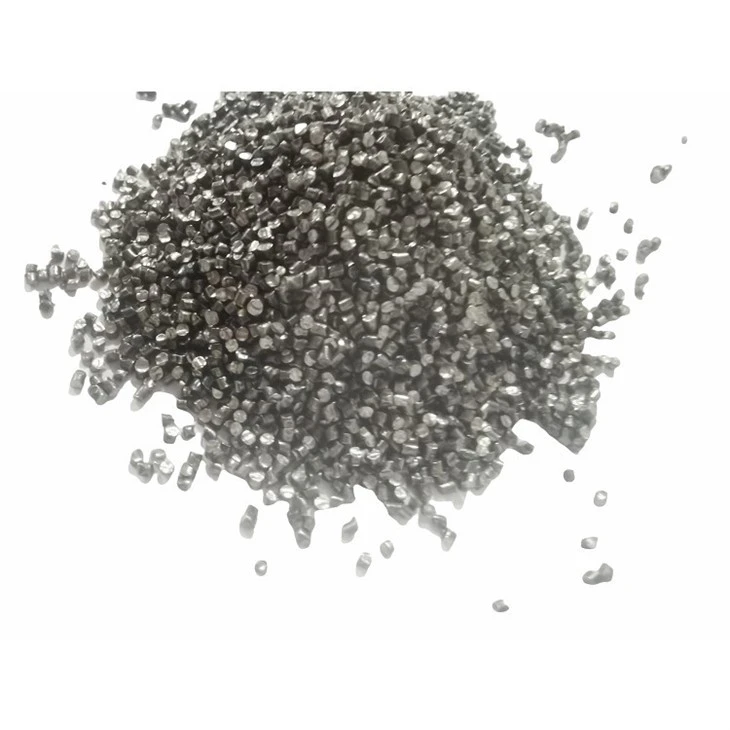
At our company, we offer a wide range of cast steel shot products to meet the diverse needs of our customers. Our products include STEEL Wire Pellet Cutting, S 460 S 660 Alloy Steel Shot, and Low Carbon Steel Shot.
We carefully control the chemical composition, manufacturing process, and heat treatment of our cast steel shot products to ensure consistent quality and performance. Our products have a well-defined Poisson's ratio within the optimal range for blasting applications, which allows for efficient energy transfer and excellent cleaning and peening results.

Contact Us for Your Cast Steel Shot Needs
If you're in the market for high-quality cast steel shot, we'd love to hear from you. Whether you're a small workshop or a large industrial operation, we have the expertise and products to meet your specific requirements. Our team of experts can provide you with detailed information about our products, including their Poisson's ratio and other technical specifications.
We're committed to providing our customers with the best possible service and products. If you have any questions or need further information, please don't hesitate to contact us. We'll be happy to assist you with your cast steel shot needs and help you choose the right product for your application.
References
- Callister, W. D., & Rethwisch, D. G. (2018). Materials Science and Engineering: An Introduction. Wiley.
- Shackelford, J. F. (2016). Introduction to Materials Science for Engineers. Pearson.


