



Hey there! As a supplier of G18 Steel Grit, I often get asked about its impact energy. So, I thought I'd take some time to break it down for you in this blog post.
First off, let's talk about what impact energy is. In simple terms, impact energy is the amount of energy that a particle can transfer when it hits a surface. For G18 Steel Grit, this is a crucial factor because it determines how effective the grit is at cleaning, peening, or shaping a surface.
The impact energy of G18 Steel Grit depends on several factors. One of the most important is the size of the grit. G18 Steel Grit has a specific size range, and generally, larger grit particles have more impact energy. This is because they have more mass, and according to the kinetic energy formula (KE = 0.5 * m * v², where m is mass and v is velocity), a greater mass means more energy when the particle is in motion.
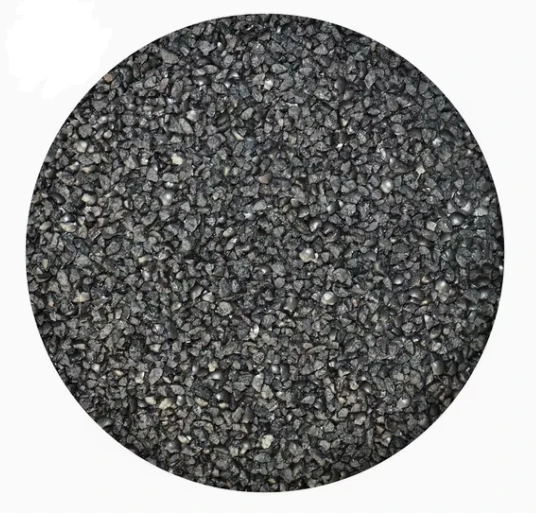

Another factor is the hardness of the steel grit. G18 Steel Grit is made from high - quality steel, which gives it a relatively high hardness. A harder grit can maintain its shape better during impact, allowing it to transfer more energy to the surface. So, when the G18 Steel Grit hits a surface, it doesn't deform easily and can effectively remove contaminants, scale, or even reshape the surface if needed.
The velocity at which the G18 Steel Grit is propelled also plays a huge role in its impact energy. When using blasting equipment, the pressure and the type of nozzle can affect the velocity of the grit. A higher velocity means more impact energy. For example, in a high - pressure blasting system, the G18 Steel Grit can be shot out at a very high speed, hitting the surface with a significant amount of force.
Now, let's talk about the real - world applications of the impact energy of G18 Steel Grit. One of the most common uses is in surface cleaning. When you need to clean a metal surface that has rust, paint, or other contaminants, the high impact energy of G18 Steel Grit can quickly remove these unwanted materials. It can reach into small crevices and pores on the surface, ensuring a thorough clean.
In the field of metal peening, the impact energy of G18 Steel Grit is used to improve the mechanical properties of metals. When the grit hits the metal surface, it creates small indentations, which induce compressive stresses. These compressive stresses can increase the fatigue life of the metal, making it more resistant to cracking and other forms of damage.
G18 Steel Grit is also used in surface finishing. The impact energy can be adjusted to achieve different levels of smoothness or roughness on the surface. For a smoother finish, you might use a lower - velocity blasting with G18 Steel Grit, while a rougher finish can be achieved with a higher - velocity blast.
Compared to other types of steel grits, like Steel Grit blasting abrasive G40, Steel Grit abrasive GP50, and Steel Grit abrasive blasting GL25, G18 Steel Grit has its own unique impact energy characteristics. G40 might have a different size and hardness, which would result in a different impact energy profile. Similarly, GP50 and GL25 are designed for specific applications, and their impact energies are tailored to those needs.
When choosing between these different types of steel grits, it's important to consider the specific requirements of your project. If you need a high - impact energy for heavy - duty cleaning or peening, G18 Steel Grit might be a great choice. But if you're looking for a more delicate surface finish, you might want to explore other options.
As a supplier, I've seen firsthand how important it is to understand the impact energy of G18 Steel Grit. It can make or break a project. If you use the wrong type of grit or don't control the impact energy properly, you might not get the desired results. That's why I'm always here to help my customers make the right choice.
If you're in the market for G18 Steel Grit or any of our other products, I encourage you to reach out. Whether you're working on a small DIY project or a large industrial job, we can provide you with the right steel grit and offer advice on how to use it effectively. We understand that every project is unique, and we're committed to helping you achieve the best results.
In conclusion, the impact energy of G18 Steel Grit is a complex but crucial aspect of its performance. It's determined by factors like size, hardness, and velocity, and it has a wide range of applications in surface cleaning, peening, and finishing. By understanding these concepts, you can make informed decisions when it comes to using G18 Steel Grit in your projects. So, don't hesitate to contact us if you have any questions or if you're ready to start your next project with our high - quality steel grit.
References
- "Principles of Abrasive Blasting" by an industry expert in abrasive materials
- Technical specifications provided by steel grit manufacturers


