



The wear rate of cast steel grit is a crucial factor that significantly impacts its performance and cost - effectiveness in various applications, especially in Steel Grit Blasting. As a seasoned cast steel grit supplier, I have witnessed firsthand how different factors can influence the wear rate of this essential abrasive material. In this blog, I will delve into the key factors affecting the wear rate of cast steel grit.
1. Material Composition
The chemical composition of cast steel grit plays a fundamental role in determining its wear rate. Cast steel grit is primarily made of iron with various alloying elements such as carbon, manganese, silicon, and chromium.
Carbon content is a critical factor. Higher carbon content generally increases the hardness of the cast steel grit. Harder grits are more resistant to wear as they can better withstand the impact forces during the blasting process. For example, GH 18 Steel Grit with a relatively high carbon content offers better wear resistance compared to some lower - carbon alternatives.
Manganese also contributes to the toughness and hardenability of the cast steel grit. It helps in improving the overall strength of the material, reducing the likelihood of premature breakage and thus lowering the wear rate. Silicon can enhance the fluidity during the casting process, which in turn affects the internal structure of the grit. A well - formed internal structure can improve the wear resistance of the cast steel grit. Chromium, on the other hand, can form a protective oxide layer on the surface of the grit, increasing its corrosion resistance and indirectly affecting the wear rate, especially in environments where corrosion may accelerate the wear process.
2. Hardness
Hardness is one of the most significant factors influencing the wear rate of cast steel grit. The harder the grit, the more resistant it is to deformation and abrasion. Hardness is typically measured using the Rockwell or Vickers hardness scales.
In a blasting operation, hard cast steel grits can maintain their shape and sharp edges for a longer time. This allows them to continue to effectively remove surface contaminants and rust from the workpiece. However, extremely hard grits may also be more brittle. If they are too brittle, they can fracture easily upon impact, leading to an increased wear rate in the form of grit breakage. Therefore, there is an optimal hardness range for cast steel grits depending on the specific application. For general surface preparation in industrial settings, a hardness range of around 40 - 50 HRC (Rockwell C scale) is often considered ideal as it provides a good balance between wear resistance and toughness.
3. Particle Size and Shape
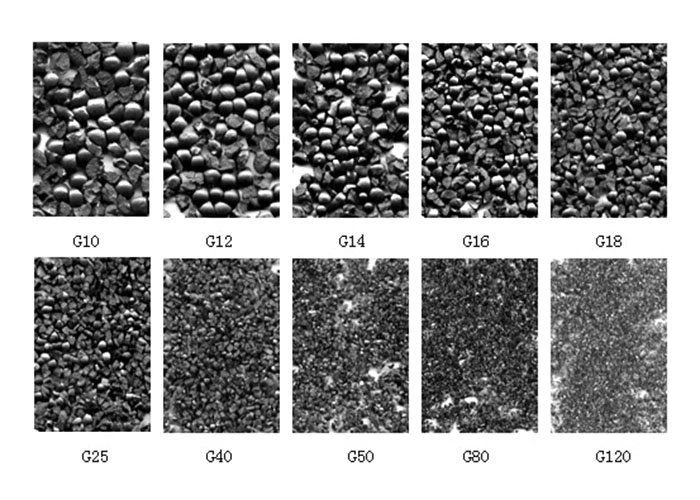
The particle size of cast steel grit has a direct impact on its wear rate. Larger particles generally have a lower surface - to - volume ratio. This means that they can withstand more impacts before being completely worn out compared to smaller particles. However, larger particles may also cause more surface roughness on the workpiece, which may not be desirable in some applications.
The shape of the cast steel grit is another important factor. Angular - shaped grits are more aggressive in terms of surface cleaning as they can penetrate the surface contaminants more effectively. However, their sharp edges are more prone to wear and breakage. Spherical - shaped grits, on the other hand, have a more uniform wear pattern and are less likely to break. They can be reused more times, resulting in a lower overall wear rate. In practice, a combination of different particle sizes and shapes may be used to optimize the blasting process and control the wear rate.
4. Blasting Parameters
The blasting parameters, including blasting pressure, blasting distance, and blasting angle, can greatly affect the wear rate of cast steel grit.
Higher blasting pressure increases the impact force of the grit on the workpiece. While this can improve the cleaning efficiency, it also subjects the grit to more severe stress, leading to a higher wear rate. Therefore, it is important to find the right balance between the blasting pressure and the desired cleaning effect.
The blasting distance also matters. If the blasting distance is too short, the grit may experience excessive impact forces and break more easily. Conversely, if the distance is too long, the impact energy of the grit may be reduced, resulting in less effective cleaning and potentially uneven wear of the grit.
The blasting angle affects how the grit interacts with the workpiece surface. A perpendicular blasting angle usually provides the most efficient cleaning, but it also subjects the grit to maximum impact. An oblique angle may reduce the impact force on the grit, which can lower the wear rate but may also decrease the cleaning efficiency.
5. Workpiece Material and Surface Condition
The material of the workpiece being blasted and its surface condition can influence the wear rate of cast steel grit. If the workpiece is made of a hard and abrasive material, the grit will experience more wear during the blasting process. For example, blasting a high - strength alloy steel workpiece will cause the cast steel grit to wear out faster compared to blasting a softer metal like aluminum.

The surface condition of the workpiece also plays a role. A heavily rusted or contaminated surface may require more aggressive blasting, which can increase the wear rate of the grit. In addition, if the surface has sharp edges or protrusions, these can cause the grit to break or wear more quickly as it collides with them.
6. Environmental Conditions
The environmental conditions in which the blasting operation takes place can affect the wear rate of cast steel grit. Humidity and temperature are two important factors. High humidity can cause the cast steel grit to rust, which weakens the material and increases its wear rate. In high - temperature environments, the mechanical properties of the cast steel grit may change, potentially reducing its hardness and toughness and leading to more rapid wear.
Dust and debris in the blasting environment can also have an impact. If there is a large amount of dust and debris, they can mix with the cast steel grit and cause additional abrasion, accelerating the wear process.
Conclusion
In conclusion, the wear rate of cast steel grit is influenced by a variety of factors, including material composition, hardness, particle size and shape, blasting parameters, workpiece material and surface condition, and environmental conditions. As a cast steel grit supplier, understanding these factors is essential for providing customers with the most suitable products for their specific applications.
By carefully considering these factors, customers can optimize the blasting process, reduce the wear rate of the cast steel grit, and ultimately save costs. Whether you are involved in Steel Grit Blasting for surface preparation in the automotive industry, shipbuilding, or any other field, choosing the right cast steel grit and controlling the relevant factors can make a significant difference in the overall efficiency and cost - effectiveness of your operations.
If you are interested in learning more about our cast steel grit products or would like to discuss your specific requirements, please feel free to contact us. We are committed to providing high - quality cast steel grit solutions tailored to your needs.
References
-ASM Handbook, Volume 12: Fractography. ASM International, 1987.
-Kutz, Myer. Mechanical Engineers' Handbook. John Wiley & Sons, 2006.
-Schreiner, E. K. (Ed.). Metal Finishing Guidebook and Directory. Industrial Press, 2010.


